Bereavement
I'd Like to Apologize to Every Teacher I Ever HadBereavement in this episode is not a single loss but a condition that shapes what can be said, what is initially held back, and how writing can make sorrow visible. The narrator’s own experience of losing his father creates a point of connection with Alex, but Alex’s account of losing both parents in violent circumstances exceeds what the narrator can imagine.
Loss and Recognition
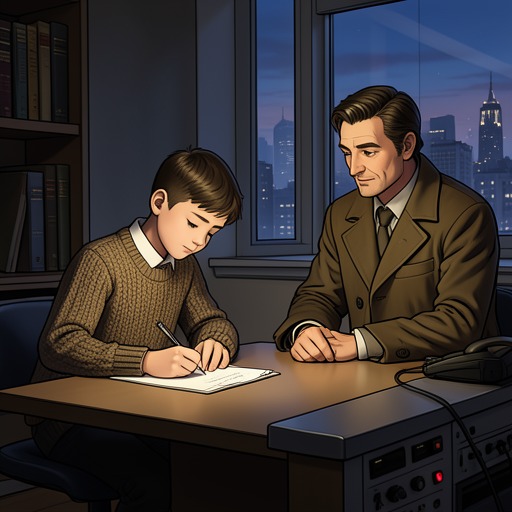
The encounter begins with poetry. When the narrator asks Alex what he writes about, Alex says that most of his poems concern his father, who was killed in a car accident. The narrator responds by sharing that he, too, lost his father, while acknowledging that he was older than Alex when it happened. Their shared bereavement offers a basis for sympathy, but it does not make their experiences equivalent.
After a pause, Alex reveals that he now writes about his mother. She was stabbed to death. The disclosure abruptly changes the encounter: the narrator rises from his chair, crosses the room, and embraces Alex. Alex accepts the hug without pushing him away, though the narrator cannot tell whether it is welcome or merely tolerated. The moment makes grief physical without resolving that uncertainty; the embrace offers care, but cannot undo either death.
The Limits of Empathy
The narrator wants to go to Alex as soon as the boy mentions his father, yet initially stays seated. When Alex speaks of his mother’s death, the narrator’s response is immediate and bodily: he is across the room in two steps, his heart hammering and tears close. He recalls the warning about an adoption fantasy, recognizing the danger of imagining that compassion alone can make him Alex’s rescuer. He asks who Alex lives with now, and learns that the explanation involves a stepuncle—a family circumstance the narrator takes time to understand.
The narrator explicitly recognizes the limit of his perspective: Alex’s life is beyond anything he can imagine. His own bereavement enables him to meet the disclosure with personal sympathy, but Alex’s losses remain distinct and more numerous. The scene holds both truths together, making attentive presence possible without claiming complete understanding.
Poetry as Testimony
The narrator asks whether Alex will let him read his writing, and Alex agrees. The next day, Alex brings an overstuffed binder of work. Its poems address bullying, sorrow, teen suicide, and helplessness, extending beyond the deaths of his parents to other forms of pain in his life. The volume of writing and the narrator’s assessment that the poems are good establish Alex not only as someone who has endured loss but as a writer shaping that experience into language.
One long poem, “I’m an Oxymoron,” expresses Alex’s inner conflicts and unsettles the narrator, yet it is also hopeful. Its closing lines bring darkness and possibility into direct tension: “I’m the bright part of life even though it’s dark” and “And at last I can be myself”. The poem does not erase the deaths or the sorrow that surrounds them. Instead, its ending makes room for a self that is more than bereavement, while allowing grief and hope to remain present in the same account.